
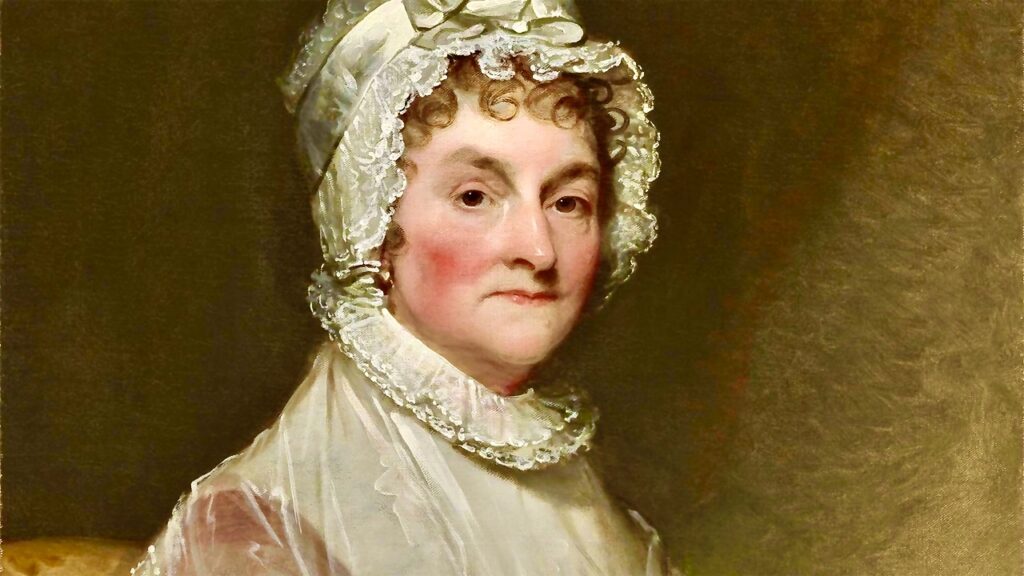
Born: November 11, 1744 Died at 73 October 28, 1818, Also Ref. Appendix A regarding “Personal,” and “Public Service.”
Summary
The White House Historical Association (TWHHA) advises Abigail Smith was born to Elizabeth and Reverend William Smith in Weymouth, Massachusetts, on November 11, 1744. Abigail, like most girls in her day did not have a formal education, however, she was a devoted reader, studying the works of William Shakespeare and John Milton among others. Per Britannica.com her father had a constant flow of interesting, intelligent, and well-educated guests at the Smith home, so that along with her self-regulated reading, the additional intellectual stimulation turned Abigail into a learned, witty young woman.
Abigail Smith and John Adams were third cousins and had known each other since they were children, although he was nine years older. The two happened to meet at a social gathering in 1761, where John saw the petite, shy 17-year-old through different eyes and was immediately smitten (Biography.com). On October 25, 1764, Abigail married John Adams, and the newlywed couple moved into his family home in Braintree (now Quincy), Massachusetts. They had seven (some biographers report six) children together but only four reached adulthood – Abigail, John Quincy, Charles, and Thomas (TWHHA).
John’s law career, service in the Continental Congress, and diplomatic missions abroad kept him away for long periods of time. That meant that the lion’s share of daily and household responsibilities were Abigail’s. She raised, nurtured, and educated their children, oversaw the farm and its tenants, as well as managing the family’s finances and investments. She additionally provided invaluable support to John in every step of his climb to the presidency. Abigail organized significant household moves to France, England, New York, Philadelphia, and Washington, D.C. Concordantly, because of their frequent separation, John and Abigail shared an extensive and wide-ranging written correspondence consisting of more than 1,100 letters (TWHHA).
Furthermore, they discussed topics such as politics, diplomacy, war, and public opinion, as well as household issues. They were a power couple. Their letters reflect a deep, intellectual and emotional affection for one another, underscored by Abigail’s directness and candor. In 1776, she famously instructed her husband to “Remember the Ladies and be more generous and favorable to them than your ancestors. Do not put such unlimited power into the hands of the Husbands. Remember all Men would be tyrants if they could.” Abigail Adams believed that women were entitled to the same rights as men for education, property, and protection under the law. While John did not take her suggestion seriously, he became more dependent on her counsel as he climbed the political ladder. After taking the oath as president, he wrote: “I never wanted your Advice and assistance more in my Life (TWHHA).”
Abigail soon joined him in Philadelphia, where she hosted social events and used these occasions to garner support and, if need be, defend her husband’s policies. While they were the first occupants, the Adamses only lived in the White House for several months. During that time, their son Charles died, and President Adams lost re-election. After leaving Washington, Abigail spent most of her time with her children, grandchildren, and friends, many of whom visited her at the Old House at Peace field. She also closely followed the career of her son John Qunicy Adams, though did not live to see him become president. She passed away on October 28, 1818, and was later entombed in the family crypt at United First Parish Church in Quincy (TWHHA).
Legacy of Faith
EBSCO states both of Abigail’s parents were members of prominent New England families of merchants, statesmen, and ministers. Abigail learned a conservative, rational Puritanism from her religious upbringing. She retained throughout her life a solid Christian faith and shared with her Puritan forebears a belief in the fundamental depravity of humankind. These religious convictions influenced her political opinions. For the Adams family, politics, faith, and music mixed on a daily basis.
In Household Gods: The Religious Lives of the Adams Family, Sara Georgini, series editor of The Papers of John Adams at Massachusetts Historical Society, presents Christianity as a pivotal framework that shaped the family’s decisions over 300 years. For John and Abigail Smith Adams, both influenced by their Puritan ancestors, this cultural lens informed how they interpreted the political impact of the American Revolution (Georgini, 2021).
During the war, Abigail was staunch in her letters to fellow revolutionaries that Christian patriotism would spur independence. “A patriot without religion in my estimation is as great a paradox, as an honest Man without the fear of God. Is it possible that he whom no moral obligations bind, can have any real Good Will towards Man, can he be a patriot who by an openly vicious conduct is undermining the very bonds of Society, corrupting the Morals of Youth, and by his bad example injuring that very Country he professes to patronized more than he can possibly compensate by his intrepidity, Generosity and honor? The Scriptures tell us righteousness exalts a Nation,” she wrote to Mercy Otis Warren in 1775.
Throughout the 1780s, Abigail slowly came to accept “High Church” worship aesthetics as legitimate manifestations of real faith, even when delivered in a foreign tongue. Hearing European church music became, for example, a potent luxury for her to seek out and enjoy. In letters home, the Yankee clergyman’s daughter rhapsodized about the “Solemnity and dignity” of hearing George Frideric Handel’s “Sublime” Messiah sung in Westminster Abbey in June 1785 (Georgini, 2021).
🇺🇸🇺🇸
Resources
Biography. Abigail Adams, Accesses October 2, 2026. Biography.com, https://www.biography.com/history-culture/abigail-adams
Caroli, Betty Boyd. Britannica-Britannica Editors, History. Article: Abigail Adams, September 18, 2026, Accessed October 2, 2026. https://www.britannica.com/biography/Abigail-Adams
EBSCO Information Services (EBSCO). Abigail Adams, Accessed October 2, 2026. https://www.ebsco.com/research-starters/history/abigail-adams
Who is EBSCO?
EBSCO is a leading provider of research databases, e-journal and e-package subscription management, book collection development and acquisition management, and a major provider of library technology, e-books and clinical decision solutions for universities, colleges, hospitals, corporations, government, K12 schools and public libraries worldwide.
Georgini, Sara. Article: “Household Gods: The Religious Lives of the Adams Family,” March 24, 2021, Accessed October 2, 2026. https://www.amrevmuseum.org/read-the-revolution/household-gods
The White House Historical Association (TWHHA). Article: Abigail Adams, Accessed October 2, 2026. https://www.whitehousehistory.org/bios/abigail-adams
Appendix A
Personal
- Birthplace: Weymouth, Massachusetts
- Religion: Theist, Congregationalist, Unitarian
- Children: Seven – Abigail Smith, Elizabeth Coombs, Thomas Boylston, Frances Foster, Isaac Hull, John Quincy, and Joseph Harrod.
- Education Level: Traditional home instruction, self-taught
Public Service
- Dates of husband’s Presidency: March 4, 1797 – March 4, 1801
- # of Terms: One
- Party: Federalist
- Public Service: First Lady 1797-1801
- Profession: Farm and household manager
Appendix B
Gallery
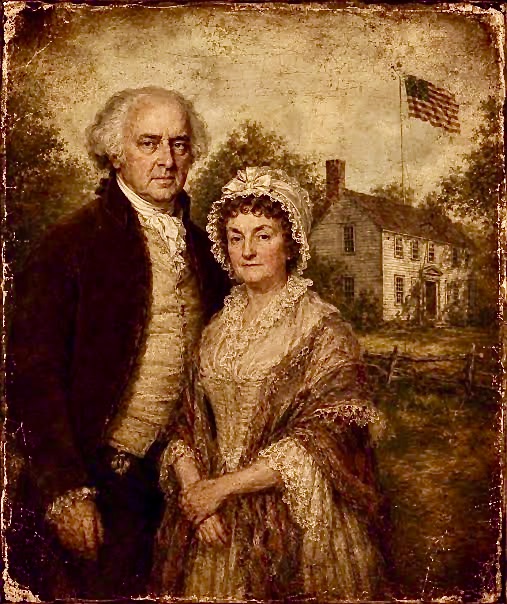
Image: Abigail and John Adams, unknown source. “Fair Use,” US Copyright Code 107 (501c3).