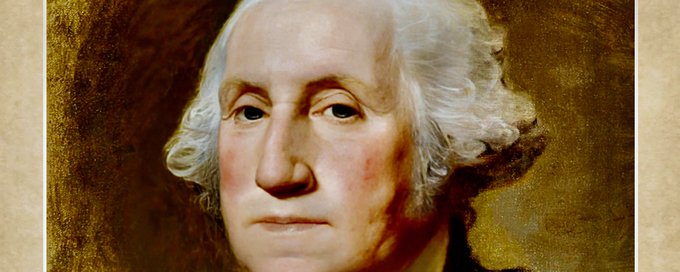
Image: George Washington, oil on canvas by Gilbert Stuart, c. 1803–05; in the National Gallery of Art, Washington, D.C.
Summary
Born: February 22, 1732 Died at 67: December 14, 1799, Also Ref. Appendix A regarding “Personal,” and “Public Service.”
George Washington was born to Augustine and Mary Washington in Westmoreland County, Virginia on February 22, 1732. He is prominent among the Founding Fathers, and the first president of the United States. Withal, Washington has graciously been styled by historians as “The Father of Our Country.” Washington’s father died when he was eleven (11) years old, and he became “a ward of his half-brother Lawrence; a man of fine character, who gave him wise and affectionate care. Lawrence also built a house and named the 2,500-acre holding Mount Vernon in honor of the admiral under whom he had served in the siege of Cartagena [Britannica].
Per Britannica, as a youth, young George was drawn to surveying as an occupation, and by 1749 Washington had sufficient experience and contacts to receive an appointment as official surveyor of Culpeper county. He kept almost constantly busy, surveying not only in Culpeper but also in Frederick and Augusta counties. Washington also made journeys far beyond the Tidewater region into the western wilderness. The experience taught him resourcefulness and endurance and toughened him in both body and mind.
Turning Point
The years 1751–52 marked a turning point in Washington’s life, for they placed him in control of Mount Vernon when Lawrence was stricken with Tuberculosis. Lawrence passed away in July of 1753 making Washington executor and residuary beneficiary of his estate should his daughter, Sarah, die without issue. As she died within two months, Washington at age 20 became head of one of the best Virginia estates. He gradually increased the estate until it exceeded 8,000 acres. He also became prominent in community affairs, was an active member and later vestryman of the Episcopal church, and as early as 1755 expressed a desire to stand for the Virginia House of Burgesses [Britannica].
Per Britannica, just after Lawrence’s death, Lieutenant Governor Robert Dinwiddie appointed George Adjutant for the southern district of Virginia (November 1752). In 1753 he became Adjutant of the Northern Neck and Eastern Shore, and eventually Lieutenant Colonel and full Colonel when service was rendered to deal with the threat of encroachment in the Ohio Valley by the French.
Washington’s bravery and poise in the midst of imminent danger –even in the midst of personal illness, won him respect and acclaim, and he would quickly rise in the ranks, so that by August 1755, while still only 23 years old, he was made commander of all Virginia troops. 1757 his health failed and in the closing weeks of that year he was so ill of a “bloody flux” (dysentery) that his physician ordered him home to Mount Vernon.
Marriage to Martha
In the spring of 1758, per Britannica, Washington had recovered sufficiently to return to duty as colonel in command of all Virginia troops. Then also in 1758, Washington, who had just been elected to the House of Burgesses, was able to resign with the honorary rank of Brigadier General. The year immediately following his resignation, on January 6, 1759, he married Martha Dandridge Custis, a widow.
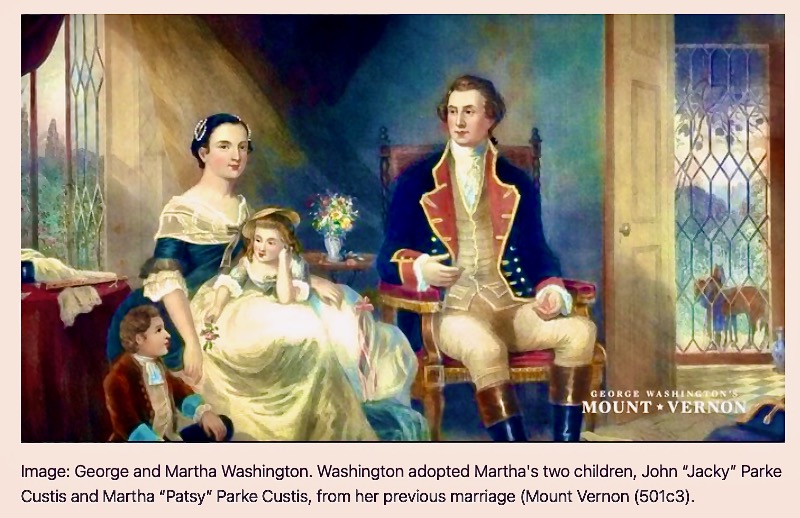
Martha brought to the marriage a considerable fortune, including an 18,000-acre estate, from which Washington personally acquired 6,000 acres. The marriage also brought Martha’s two young children from her prior marriage, John “Jacky” Parke Custis and Martha “Patsy” Parke Custis. George and Martha would have no “natural” children from their union, however Washington cherished Martha’s as his own [Britannica].
Per Biography.com, with regard to The Revolutionary War – The choice of Washington as commander in chief of the military forces of all the colonies followed immediately upon the first fighting. After the war, Washington played a crucial role in the creation of the U.S. Constitution, and later was unanimously selected as America’s first president, serving from 1789 to 1797.
Presidential Precedents
The White House Historical Association (TWHHA) reports Washington established countless presidential precedents during his tenure – some of Washington’s traditions guide executive etiquette, and endure to this day. Notably, he created the structure and function of the president’s cabinet, asserted executive privilege, and used the first ever presidential veto.
Washington’s executive actions defined presidential authority over domestic, and foreign diplomacy. Examples include Washington’s crafting of foreign policy during the Neutrality Crisis in 1793 and domestically subduing the Whiskey Rebellion in 1794. Perhaps most importantly, Washington again relinquished his power when he retired after two terms in office [TWHHA].
This precedent was reinforced by Thomas Jefferson and followed by every successive president until Franklin D. Roosevelt. In 1951, the states ratified the 22nd Amendment, which limits presidents to two terms in office. Washington, looked longingly to his retirement, however, as providence would decide – he died December 14, 1799, of a throat infection, less than three years after leaving office [TWHHA].
Emancipated Servants
When Washington inherited Mt Vernon, he had to manage the 18 slaves that came with the estate; he would continue to acquire others. At the time of his death, more than 300 slaves were housed in the quarters on his property. His care of slaves was said to be exemplary; few ever ran away (Britannica.com). He carefully clothed and fed them, engaged a doctor for them by the year, generally refused to sell them—“ He had been unwilling to sell slaves lest families be broken up, even though the increase in their numbers placed a burden on him for their upkeep and gave him a larger force of workers than he required, especially after he gave up the cultivation of tobacco. [Britannica]
Washington’s will provided for the immediate freedom of William Lee, his enslaved valet, who served with him during the American Revolution. It also freed the other 122 people he enslaved upon Martha’s death, though she freed them by 1800. Despite enslaving people for 56 years, Washington was the only Founding Father (and/or president) to emancipate everyone he held in bondage [Britannica].
Legacy of Faith
Per American Experience, God In the White House, Washington’s faith has been speculated as Evangelical Christianity, Diest, and Free Masonry—yet evidence dictates he was a devout Anglican, who was baptized as an infant, and remained active throughout his life. He was a Vestryman; his wife Martha worshiped at Christ Church. History confirms that Washington believed in a God who responded to prayer and human need. In the battlefield he reported “I have been protected beyond all human probability or any expectation.”
Washington, as others of the Founders, struggled with the question of how to impart morality and virtue to a diverse people. He believed that (morality) to be essential to creating a responsible and successful Democracy.
Farewell Address:
“Of all the dispositions and habits which lead to political prosperity, religion and morality are indispensable supports… And let us with caution indulge the supposition that morality can be maintained without religion. Whatever may be conceded to the influence of refined education on minds of peculiar structure, reason and experience both forbid us to expect that national morality can prevail in exclusion of religious principle.”
By the President of the United States of America a Proclamation:
Whereas it is the duty of all Nations to acknowledge the Providence of Almighty God, to obey His will, to be grateful for His benefits, and humbly implore His protections and favor—and whereas both Houses of Congress have by their joint committee requested me to recommend to the people of the United States a day of public thanksgiving and prayer- [American Experience].
America’s Presidents and First Ladies | Dr. Donna Williams Smith, George Washington (1), Created August 14, 2025, Revised October 1, 2026, “Fair Use,” US Copyright Code 107, 1976 (501c3)
🇺🇸🇺🇸
[a] Header Image: George Washington, oil on canvas by Gilbert Stuart, c. 1803–05; in the National Gallery of Art, Washington, D.C.
References
American Experience, Article | God in the White House, God in America, George Washington. www.PBS.org, accessed December 2, 2024. https://www.pbs.org/wgbh/americanexperience/features/godinamerica-white-house
Nevins, Alan; Britannica Editors. “George Washington, 1st president of the United States, Also known as: Father of His Country.“Updated September 28, 2026, Accessed September 30, 2028. Picotti, Tyler; Caruso, Catherine. George Washington, Biography.com . Famous Political Figures, Accessed October 1, 2026. https://www.biography.com/political-figures/a71233431/george-washington-us-president.
The White House Historical Association. George Washington. https://www.whitehousehistory.org/bios/george-washington
, accessed August 14, 2025.
Appendix A
Personal
Born: February 22, 1732 Died at 67: December 14, 1799
- Birthplace: Westmoreland County, VA
- Religion: Church of England, Episcopal
- First Lady: Martha Washington
- Children: 2 adopted
- Education Level: irregular; tutoring; Schoolmaster, No College
- Profession: Military (War Hero), Surveyor, Planter
Public Service
- Dates of Presidency: April 30, 1789 – March 3, 1797
- # of Terms: 2
- Vice President: John Adams
- Party: Independent
- Colonial Government: House of Burgesses (1758-1774), Continental Congress (1774-1775)
- Other Offices: General and Commander in Chief of the Colonial Armies & US Armed Forces, President of Constitutional Convention
Appendix B
Gallery
Image: George and Martha Washington. Washington adopted Martha’s two children, John “Jacky” Parke Custis and Martha “Patsy” Parke Custis, from her previous marriage (Mount Vernon (501c3).